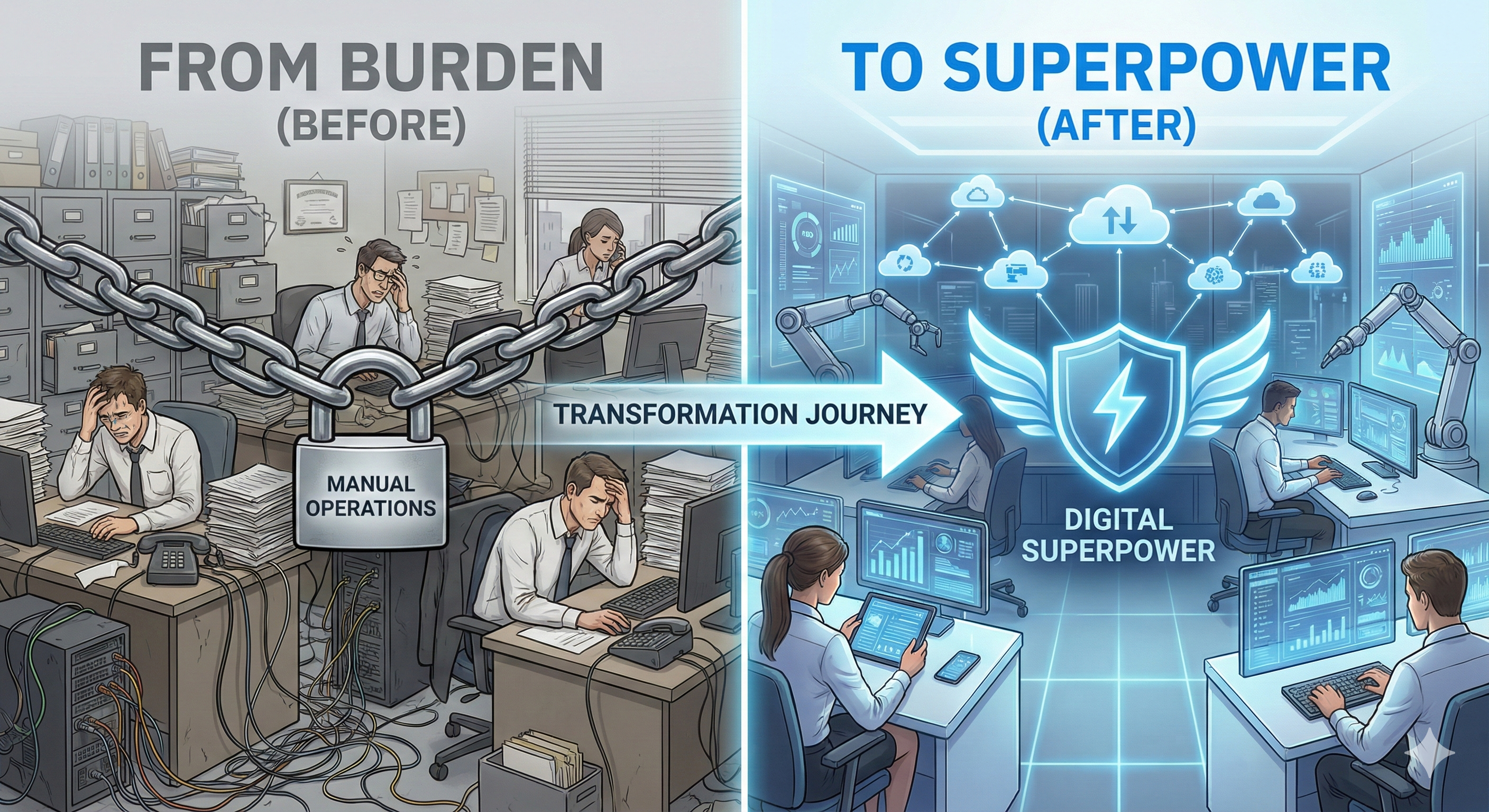

Article 4 of our Digital Transformation Journey. We've seen the problems (Articles 1-2) and the possibilities (Article 3). Now let's talk about the fundamental mindset shift that makes transformation work.
Imagine two companies. Same industry. Similar size. Similar challenges.
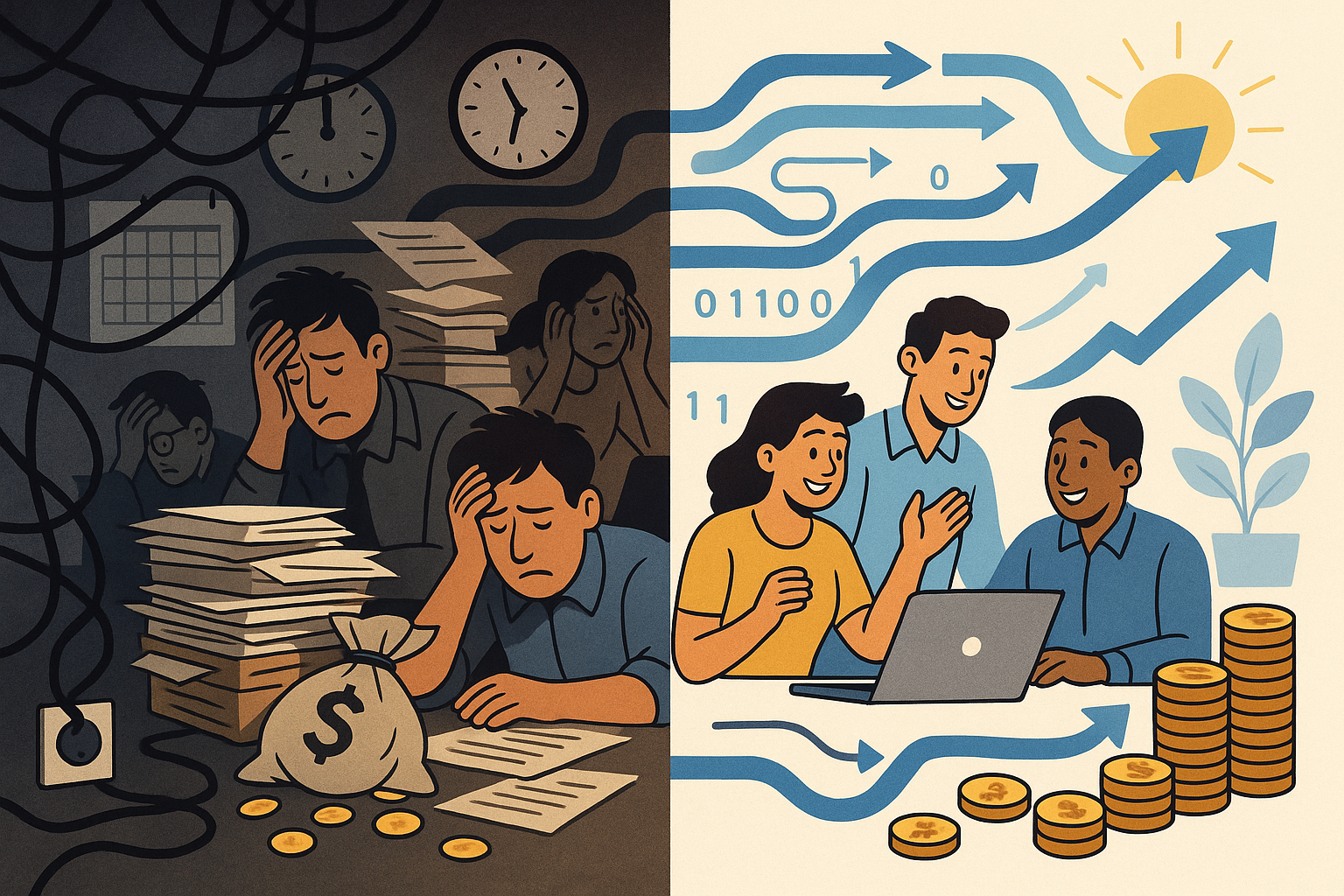
Company A spends every Monday morning firefighting. Systems crashed over the weekend. A customer complaint needs immediate attention. An urgent data request from leadership. By Friday, they've survived another week.
Company B spends Monday morning reviewing opportunities. Their real-time dashboard revealed an interesting trend. Customer insights suggest a new service offering. A proactive alert prevented an issue before it happened. By Friday, they've advanced their strategy.
Five years later, Company A is still the same size, struggling with the same problems. Company B has doubled revenue, expanded to new markets, and become the industry benchmark.
The difference? Their relationship with technology.
In the three articles preceding this one, we've identified digital chaos warning signs, calculated the staggering cost of inaction, and shown you what success looks like. Now we need to address the fundamental shift that determines success or failure: moving from reactive to proactive.
This isn't just about better systems. It's about a different way of thinking.
The Reactive Technology Trap
Let's be honest about how most businesses relate to technology.
What Reactive Looks Like
You call IT only when something breaks. Technology is like the plumbing—you ignore it until there's a problem, then panic.
You choose software based on immediate pain points. "We need something to fix THIS problem RIGHT NOW" without thinking about how it fits into the bigger picture.
You have no technology roadmap or strategy. You're not planning ahead. You're responding to crises as they occur.
Band-aid solutions and workarounds become normal. "Just use this spreadsheet until we figure out something better" becomes permanent.
Budget surprises from emergency fixes. You didn't plan for this expense, but now it's urgent, so you have no choice.
"If it ain't broke, don't fix it" is your mantra. Even when it's clearly broken, as long as it's limping along, you avoid dealing with it.
How You Got Stuck Here
You didn't plan to operate this way. Here's how it typically happens:
You started small. Technology was just a necessary expense. You hired someone who "knew computers" or outsourced IT to keep things running. Each new problem got a point solution. No one "owned" technology strategy.
Before you knew it, firefighting became the cultural norm. Being in crisis mode felt normal. You became the business equivalent of someone living paycheck to paycheck—surviving week to week with no room to plan ahead.
The Real Cost
Beyond the financial costs we calculated in Article 2, there's something more insidious: You're always playing catch-up.
Innovation happens TO you, not BY you. You're responding to market changes instead of creating them. Team morale suffers from constant crisis mode. Strategic opportunities get missed because you're too busy bailing water.
Remember the five warning signs from Article 1? They're all symptoms of reactive technology management.
The Proactive Technology Mindset
Now let's talk about what changes when you flip the script.
What Proactive Looks Like
Technology aligned with business strategy. You're not just solving problems—you're enabling growth. Technology decisions support where you want to go, not just where you are.
Planned upgrades and improvements. You schedule updates during convenient times, not during crises. You're improving systems before they fail.
Systems anticipate future needs. You're building for 3× your current size, not just today's requirements. Growth doesn't break your systems.
Data informs strategic decisions. You're not just answering questions when asked—insights surface automatically, revealing opportunities you didn't know to look for.
Budget allocated to innovation AND maintenance. You're investing in getting better, not just staying afloat.
The Fundamental Shift
This represents a change in how you think about technology:
- From "What's broken?" to "What's possible?"
- From cost center to investment portfolio
- From IT department to strategic partner
- From firefighting to forest management
Think about the examples from Article 3—the service company that went from dispatch chaos to real-time optimization, or the business that went from billing guesswork to profitability science. None of them got there by just fixing what was broken. They reimagined what was possible.
Three Levels of Technology Maturity
Let's diagnose where you are and where you're going.
Level 1: Reactive (Survival Mode)
Characteristics:
- Emergency fixes are normal
- No planning beyond next quarter
- Systems are siloed and disconnected
- Technology surprises you monthly
- Budget only for "keeping lights on"
Business Impact:
- High stress, poor efficiency
- Lost opportunities you never see
- Team frustration is constant
- Customer experience is unpredictable
Growth Limitation: You can't scale without everything breaking. Growth feels dangerous instead of exciting.
You're here if: Technology regularly surprises you, and not in a good way.
Level 2: Stable (Maintenance Mode)
Characteristics:
- Things generally work
- Basic planning is in place
- Some integration between systems exists
- You budget for upgrades
- Fewer surprises
Business Impact:
- Predictable operations
- Moderate efficiency
- Keeping pace with the market
- Room to breathe
Growth Limitation: Growth requires manual scaling. You need to add headcount proportionally to add capacity.
You're here if: Technology works but doesn't wow anyone, including you.
Level 3: Proactive (Growth Mode)
Characteristics:
- Strategic alignment between business and technology
- Systems designed for scale from the start
- Automation of repetitive work
- Predictive insights informing decisions
- Innovation budget and culture
Business Impact:
- Competitive advantage from technology
- High efficiency creating margin
- Rapid adaptation to market changes
- Technology attracts and retains talent
Growth Enabler: Technology accelerates growth. You can scale without proportional cost increases.
You're here if: Technology gives you capabilities competitors don't have, and customers notice.
Most businesses reading this are at Level 1 trying to get to Level 2, or at Level 2 wanting to reach Level 3. The good news? The path is clear.
How Technology Becomes a Growth Engine: 5 Strategies
Let's get tactical. Here are five specific strategies for shifting from reactive to proactive.
Strategy #1: Use Data to Spot Opportunities Before Competitors
The Concept: Your systems generate valuable data. Most businesses use data reactively—answering questions when asked. Proactive businesses use data to reveal opportunities automatically.
Reactive Approach:
- "Can someone pull Q2 numbers?"
- "What were sales in the Northeast?"
- "Why did we lose that customer?"
Proactive Approach: Your dashboard automatically shows:
- Q2 trending 15% above target
- Northeast conversion rates dropped 20% (investigate why)
- Three customers showing early warning signs of churn (trigger retention outreach)
How to Implement: Set up automated analytics with alerts for anomalies and opportunities. Stop waiting for questions—proactively surface insights.
Why It Matters: Speed of insight creates competitive advantage. While competitors are pulling last quarter's reports, you're acting on today's trends.
Strategy #2: Automate to Free Your Team for Strategy
The Concept: Human brainpower is your most valuable resource. Every hour spent on repetitive tasks is an hour not spent on strategy, innovation, or customer relationships.
Reactive Approach:
- People compensate for poor systems
- Manual workarounds become "just how we do it"
- Best employees spending time on lowest-value work
Proactive Approach:
- Automation handles routine tasks
- People focus on complex problems and relationships
- Team working on what only humans can do
How to Implement: Identify tasks done more than 3 times weekly. Document the process. Automate ruthlessly. Use the "Spreadsheet Shuffle" pattern from Article 1 to find automation candidates.
Why It Matters: Your team's creativity and judgment are irreplaceable. Repetitive data entry is not. Free them to focus on what creates value.
Strategy #3: Create Digital Experiences Competitors Can't Match
The Concept: Customer experience is the new competitive battlefield. Price and product quality are table stakes. Experience differentiates.
Reactive Approach:
- Match what competitors offer
- Respond to customer requests
- Fix complaints as they arise
Proactive Approach:
- Innovate experiences that set new standards
- Anticipate customer needs
- Create "wow" moments automatically
Example: Imagine a service company implementing a customer portal where clients can:
- Track projects in real-time (like tracking a package)
- See photos as work progresses
- Approve changes digitally
- Rate service immediately
- Schedule follow-ups themselves
While competitors are still using email and phone calls, you're delivering an experience customers remember and talk about.
How to Implement: Map your customer journey. Identify every friction point. Use technology to eliminate friction and add delight.
Strategy #4: Build Scalability Before You Need It
The Concept: Growth shouldn't break your systems. Reactive businesses hit capacity constraints and then scramble. Proactive businesses design for 3-5× current scale.
Reactive Approach:
- Fix capacity issues as they arise
- "We'll cross that bridge when we come to it"
- Growth creates operational chaos
Proactive Approach:
- Systems designed to scale from day one
- Cloud infrastructure that grows automatically
- Processes built for 3× current volume
Why It Matters: When a big opportunity appears, you can say "yes" confidently. You're not turning down business because your systems can't handle it.
How to Implement: When choosing systems, always ask: "Can this handle 3× our current volume?" Don't optimize for today—optimize for where you'll be in 24 months.
Strategy #5: Turn Insights Into Action Faster Than the Market
The Concept: Speed of insight-to-action creates competitive moats. The faster you can see a problem or opportunity and respond, the more you win.
Reactive Approach:
- Monthly meetings to review last month's data
- Decisions based on outdated information
- By the time you act, the moment has passed
Proactive Approach:
- Real-time data drives daily decisions
- Automatic alerts for significant changes
- Insights trigger actions immediately
Example: Consider a manufacturer implementing sensors on production equipment. Instead of discovering quality issues during final inspection (reactive), they detect micro-variations during production (proactive).
The time from insight to action goes from days to minutes.
How to Implement: Reduce lag time between data generation and decision-making. Ask: "How can we know this sooner and act faster?"
Making the Shift: Your 90-Day Proactive Plan
You can't flip a switch and become proactive overnight. But you can start the shift in 90 days.
Days 1-30: Assessment & Vision
Week 1-2: Audit Current State
- Review how you currently use technology
- Identify every "firefighting" moment from the past month
- List every manual process taking more than 30 minutes weekly
- Calculate time spent on reactive vs. proactive work
Week 3-4: Interview Your Team Ask them:
- What frustrates you most?
- What would make your job easier?
- What opportunities do we miss because of current systems?
- What would you do if systems were better?
By Day 30, You Should Have:
- Clear picture of reactive patterns
- List of quick-win opportunities
- Team buy-in (they helped identify problems)
- One "proactive pilot" identified
Days 31-60: Strategy Development
Week 5-6: Define "Proactive" for Your Business
- What does proactive look like in your context?
- Which of the five strategies has the highest impact?
- What metrics will measure success?
Week 7-8: Create 12-Month Technology Roadmap
- Align with business objectives
- Identify dependencies and sequencing
- Budget for maintenance AND innovation
- Assign ownership and accountability
By Day 60, You Should Have:
- Written roadmap with quarterly milestones
- Budget allocation
- Executive sponsor committed
- Success metrics defined
Days 61-90: First Proactive Moves
Week 9: Implement One Quick-Win Automation Choose something that:
- Takes less than 2 weeks to implement
- Affects multiple people
- Has visible impact
- Builds credibility
Example: Automate a report that currently takes 3 hours to produce weekly.
Week 10: Set Up One Strategic Dashboard Choose 5-7 metrics that matter most. Display them in real-time. Review them daily (not monthly).
Week 11: Launch One Customer-Facing Improvement Something customers notice immediately.
Example: Automated appointment confirmations and reminders.
Week 12: Celebrate and Communicate
- Share results from quick wins
- Communicate the roadmap
- Recognize team members who helped
- Build momentum for next phase
By Day 90, You Should Have:
- Proof that proactive works (quick wins delivered)
- Team excitement building
- Leadership support solidified
- Clear path forward
The Mindset Shifts Required
Making this work requires changing how you think. Here are four critical mindset shifts:
Shift #1: From "If It Ain't Broke" to "How Can We Make Good Even Better?"
Old mindset: "Everything's working fine. Why change?"
New mindset: "It's working fine for today. But what about tomorrow? And what if we could make it great instead of just fine?"
The businesses thriving in your industry didn't transform because things were completely broken. They transformed because they wanted to be great.
Shift #2: From "We Can't Afford to Invest" to "We Can't Afford Not To"
Old mindset: "That's a lot of money. Let's wait until we have more budget."
New mindset: "Staying where we are costs more than transforming. Every month we wait makes it more expensive."
Reference Article 2's cost calculations. Waiting is the expensive option.
Shift #3: From "Technology Is Complicated" to "Strategy Is Ours, Implementation Is Partnership"
Old mindset: "We don't understand technology well enough to make these decisions."
New mindset: "We understand our business better than anyone. We'll partner with experts who understand technology. Together we'll build something great."
You don't need to become a technology expert. You need to be crystal clear about your business needs and partner with people who can translate that into technology.
Shift #4: From "Let's See What Competitors Do" to "Let's Create What Competitors Copy"
Old mindset: "We'll wait and see what works for others, then follow."
New mindset: "We'll innovate, learn fast, and set the standard others chase."
First-mover advantage in your market could be worth millions. By the time competitors copy your innovation, you're already on to the next improvement.
Common Obstacles & How to Overcome Them
Let me address the four objections we hear most:
Obstacle #1: "We're Too Busy Firefighting"
The Reality: That's exactly the problem. You're too busy bailing water to fix the leak.
Solution: Dedicate just 5% of time to proactive work. That compounds. One hour per week, per person, across a 20-person team equals over 1,000 hours per year. Enough to make serious progress.
Start small. The 90-day plan above is designed to fit around your existing workload.
Obstacle #2: "Budget Is Allocated to Keeping Things Running"
The Reality: Yes, because you're reactive. A large portion of your technology budget goes to maintenance because your systems require constant attention.
Solution: Show the 5-year total cost comparison from Article 2. The status quo is more expensive. You're not asking for MORE budget—you're asking to redirect it to something with better ROI.
Obstacle #3: "Our Team Will Resist Change"
The Reality: Some will. Initially. But resistance often becomes advocacy when done right.
Solution: Involve them from day one (the 90-day plan does this). People resist change imposed on them. They embrace change they helped create.
Also: Some resistance is healthy. It surfaces real concerns. Address them rather than dismiss them.
Obstacle #4: "We Don't Have Technical Expertise"
The Reality: Good. You shouldn't need it in-house.
Solution: Partner with experts who become strategic advisors, not just vendors. Look for partners who ask about your business before talking about technology.
Your Action Items This Week
The shift from reactive to proactive starts with honest assessment.
This Week:
- Track Your Reactive TimeFor one week, log every hour spent on reactive technology issues (firefighting, workarounds, etc.). Calculate the cost using your loaded hourly rate. That's your weekly "reactive tax."
- Identify Your LevelAre you Level 1 (Survival), Level 2 (Stable), or Level 3 (Growth)? Be honest.
- Choose Your StrategyWhich of the five strategies (data, automation, experience, scalability, speed) would have the biggest impact on your business?
- Start Your 90-Day PlanDon't wait for perfect conditions. Block time on your calendar for Days 1-30 activities.
What's Coming Next
Next week (Article 5): We'll get tactical with "The 3-Pillar Framework"—the specific, step-by-step approach every successful transformation follows. You'll learn exactly where to start and how to sequence your transformation for maximum success.
In two weeks (Article 6): We'll tackle the technology decision that paralyzes many businesses: "Cloud, AI, or Custom Software First?" You'll get a clear decision framework.
The shift from reactive to proactive isn't optional anymore. It's the difference between companies that thrive and companies that survive.
The question is: Which will you be?
Series Progress:
- ✅ Article 1: Identified the five warning signs
- ✅ Article 2: Calculated the real costs
- ✅ Article 3: Envisioned what success looks like
- ✅ Article 4: Understood the mindset shift (today)
- Coming Next: The practical framework for getting started
Ready to make the shift from reactive to proactive? Contact SunNet Solutions to discuss how we can help you move from firefighting to strategic growth.
This is part 4 of our 6-month Digital Transformation Journey. Each article builds on the previous ones, creating a complete roadmap from chaos to sustained success.